

Shop Dental Elevators – High-Precision Root & Tooth Elevators
In the world of oral surgery, the success of a tooth extraction is often determined before the forceps even touch the tooth. The real work happens with the dental elevator. As a cornerstone of any surgical kit, the dental elevator is designed to luxate teeth, sever the periodontal ligament, and expand the alveolar bone.
At Dentify Instruments, we understand that precision and durability are non-negotiable. In this guide, we will explore the mechanics, types, and maintenance of dental elevators to help clinicians achieve predictable, atraumatic results.
1. The Role of Elevators in Modern Dentistry
The primary objective of using an elevator is to loosen the tooth from its socket (the alveolus). Unlike forceps, which are used for “pulling” or “grasping,” elevators work on the principles of physics specifically the lever, the wedge, and the wheel-and-axle.
Using an elevator correctly minimizes the force required during the final extraction, which significantly reduces the risk of:
- Alveolar bone fractures.
- Root tip fractures.
- Trauma to the surrounding soft tissue.
- Post-operative pain for the patient.
2. The Anatomy of a High-Quality Elevator
Every Dentify dental elevator is engineered with three distinct parts:
- The Handle: Our handles are ergonomically designed to provide a secure grip, preventing slippage even when gloves are wet. A good handle allows the dentist to apply controlled force without hand fatigue.
- The Shank: This connects the handle to the blade. It must be tempered perfectly too soft, and it bends too brittle and it snaps. We use surgical grade stainless steel to ensure maximum torque resistance.
- The Blade: The working end. Whether it is concave, flat, or pointed, the blade is the most critical element for engaging the tooth structure.
3. Essential Types of Dental Elevators
Not all extractions are the same, which is why a variety of elevator patterns is essential for any clinic.
A. Straight Elevators (Bein Patterns)
The straight elevator is the most commonly used tool for luxation. The blade has a concave surface that faces the tooth. It acts as a wedge to create space between the tooth and the bone.
- Best for: Maxillary and mandibular extractions where there is sufficient space to engage the root.
B. Coupland Elevators
Coupland elevators are similar to straight elevators but feature a sturdier, broader blade. They are often used in sets of three (Sizes 1, 2, and 3) to gradually increase the space in the socket.
- Best for: Splitting multi-rooted teeth and expanding dense alveolar bone.
C. Cryer Elevators (East & West)
Recognizable by their triangular blades, Cryer elevators work on the “wheel-and-axle” principle. They are typically used in pairs.
- Best for: Removing retained roots specifically when one root of a mandibular molar has been removed and the other remains.
D. Warwick James Elevators
These feature a fine, delicate blade and come in a set of three: one straight and two angled (left and right).
- Best for: Extracting impacted third molars (wisdom teeth) and delicate root fragments.
E. Root Tip Pick Elevators
These are very slender, sharp instruments designed to reach deep into the socket.
- Best for: Teasing out fractured root tips that are otherwise inaccessible.
4. The Physics of Extraction: How Elevators Work
To master the use of elevators, one must understand the three mechanical principles they employ:
- The Lever Principle: The elevator acts as a first-class lever. The bone acts as the fulcrum, and the tooth is the “load.” By applying pressure to the handle, the blade lifts the tooth out of the socket.
- The Wedge Principle: The blade is forced into the periodontal ligament space. Because the blade is thicker than the space, it expands the bone and severs the ligament.
- The Wheel and Axle: Used primarily with triangular elevators (like the Cryer). Rotating the handle (the wheel) transmits a powerful force to the blade (the axle), dislodging the root.
5. Why Material Choice Matters (Surgical Grade Steel)
At Dentify Instruments, we manufacture our elevators using high-carbon stainless steel. This is crucial for two reasons:
- Sterilization Longevity: Dental tools undergo thousands of autoclave cycles. Our steel is resistant to corrosion and “pitting,” ensuring the instrument remains sterile and safe for years.
- Edge Retention: An elevator must be sharp to engage the periodontal ligament. Low-quality steel dulls quickly leading to “slippage,” which can cause significant injury to the patient’s palate or tongue.
6. Maintenance and Care for Longevity
To ensure your Dentify elevators perform at their peak, follow these maintenance tips:
- Pre-Cleaning: Always rinse instruments immediately after use to prevent blood and debris from drying in the serrations or joints.
- Ultrasonic Cleaning: Use an ultrasonic bath with a pH-neutral detergent to remove microscopic particles.
- Inspection: Regularly check the blades for burrs or nicks. A dull elevator requires more force, increasing surgical risk.
- Proper Sterilization: Ensure the autoclave reaches the correct temperature and pressure, and never “over-stack” the tray, as this can lead to uneven heating.
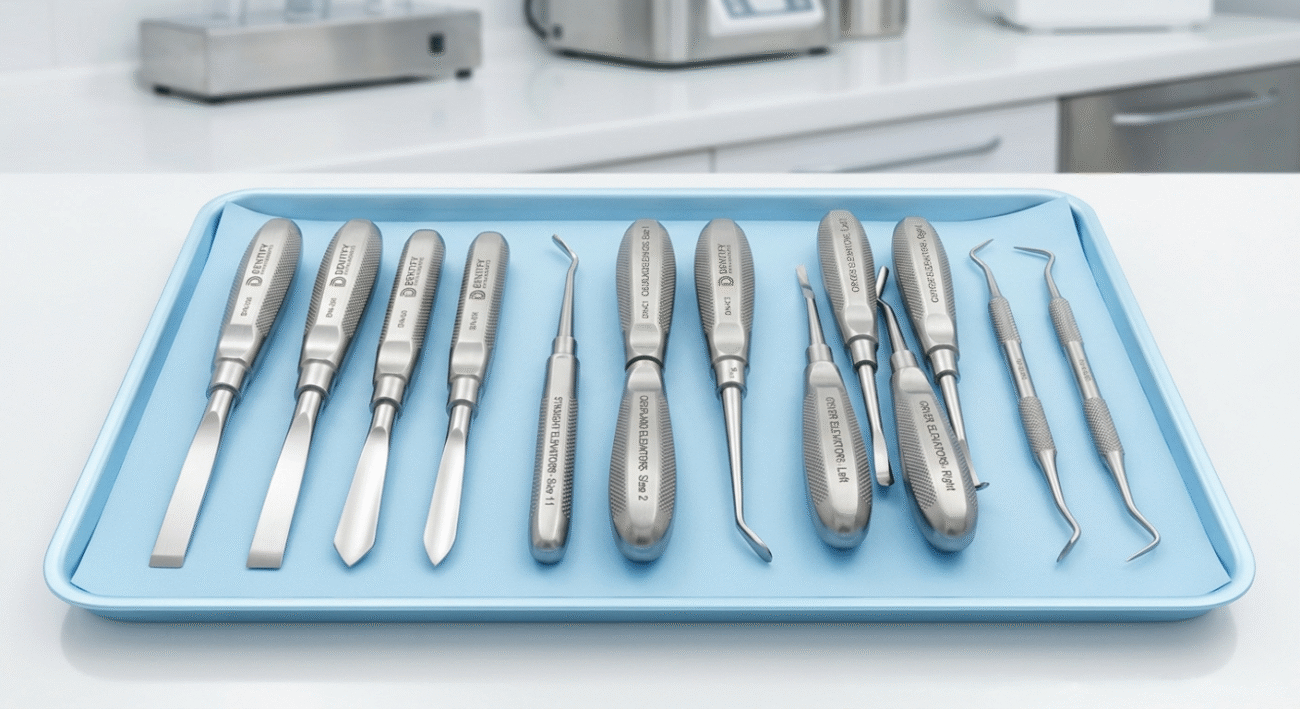
Professional set of surgical stainless steel dental elevators by Dentify Instruments, including Cryer, Bein, and Coupland patterns for extraction.